Canada in WWI: Vimy Ridge, Passchendaele, and the Cost of War
When Britain declared war in August 1914, Canada was at war too — automatically, as a Dominion, with no say in the matter. Four years later, Canada had an army of its own, a seat at the peace table, and a casualty list that touched almost every town in the country. The war made Canada a nation in the eyes of the world, and it tore the country apart at home. The ridge the Canadians took at Vimy in April 1917 is still the place where Canada remembers what the war cost.
In short
More than 600,000 Canadians served in the First World War, out of a population of about 8 million, and about 60,000 died and more than 170,000 were wounded. The Canadian Corps, formed in 1915, fought as a single national force for the first time at Vimy Ridge on 9–12 April 1917, where all four divisions attacked together and took the ridge at a cost of 3,598 killed and about 7,000 wounded. The war also brought the Conscription Crisis of 1917, which divided French and English Canada, and the Halifax Explosion of December 1917, which killed about 2,000 people. Canada signed the Treaty of Versailles separately in 1919 and joined the League of Nations, and the Statute of Westminster of 1931 gave it full control of its foreign policy.
A country goes to war
On 4 August 1914, Britain declared war on Germany, and Canada — as a Dominion of the British Empire — was automatically at war as well. There was no vote in Ottawa about whether to go; there was only a vote about how many men to send. The government of Robert Borden promised 25,000 volunteers, and within weeks 32,000 men had crowded into the new camp at Valcartier in Quebec. By the end of the war, more than 600,000 Canadians had served, most of them volunteers, out of a population of about 8 million — a share of the population no other country matched except Britain itself.
The first Canadians reached France in early 1915, and their first great battle was the Second Battle of Ypres in April 1915, where the Germans used poison gas for the first time on the Western Front. The Canadians held the line, at terrible cost, and the battle became a legend at home. In September 1915 the Canadian Corps was formed, bringing the Canadian divisions together under one command — the first time Canada had fought as a single national army. Its commander, first Julian Byng and then Arthur Currie, built it into one of the best fighting forces on the Western Front: careful planners, hard trainers, and famous for taking objectives others had failed at.
Vimy Ridge
Vimy Ridge was a long, heavily defended hill in northern France, near Arras, held by the Germans since 1914. The British and French had tried to take it before and failed, with more than 100,000 casualties. In April 1917 it was Canada's turn. For months the Canadians prepared: they built a full-scale model of the ridge behind the lines, rehearsed the attack on ground marked out like the real thing, tunnelled under no man's land, and planned a creeping barrage — a wall of shellfire that advanced just ahead of the infantry, keeping the Germans in their dugouts until the Canadians were on top of them.
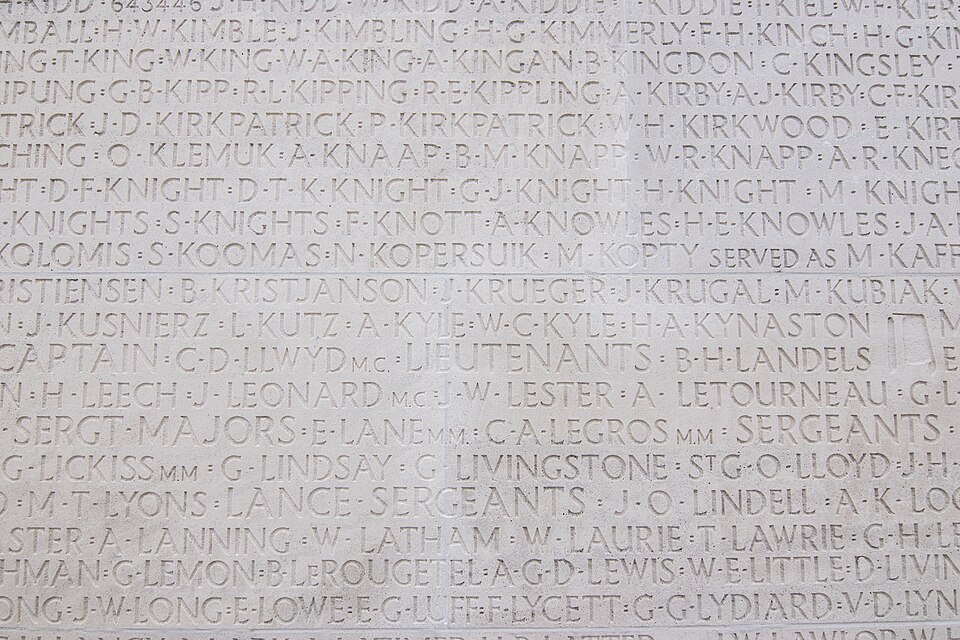
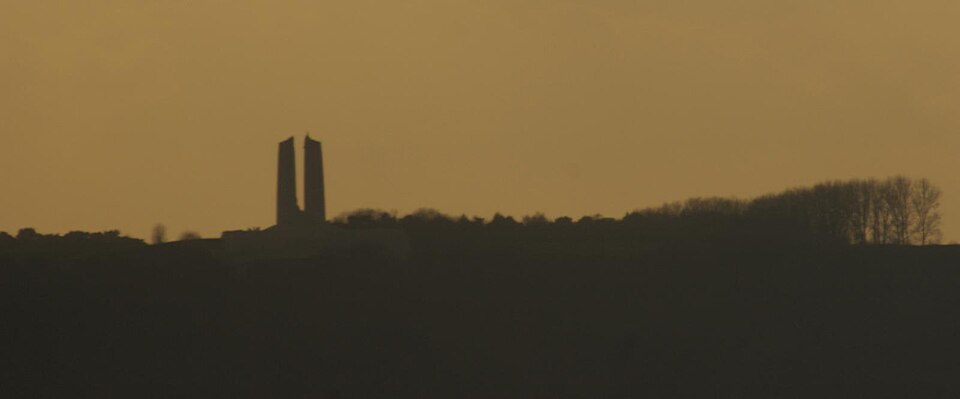
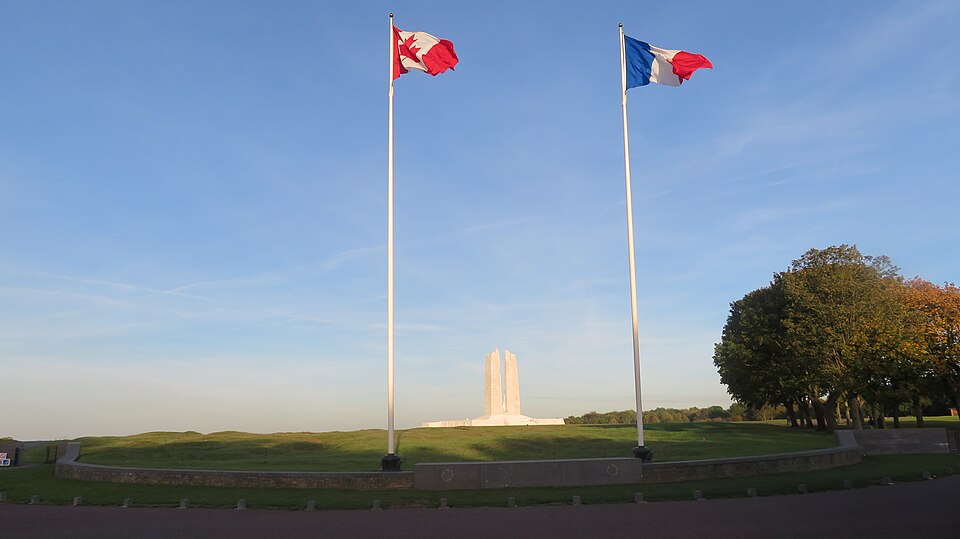
At 5:30 in the morning on Easter Monday, 9 April 1917, the first wave of about 15,000 Canadians went over the top, and for the first time all four Canadian divisions fought side by side. Most of the ridge was taken by noon that day, and the last part, the Pimple, fell on 12 April. The cost was 3,598 Canadians killed and about 7,000 wounded — 10,602 casualties in all. The victory was real, but so was the price, and the ridge is now the site of the Canadian National Vimy Memorial, unveiled in 1936, a gleaming white monument on the hilltop that bears the names of 11,285 Canadians killed in France who have no known grave. It is often said that Canada 'came of age' at Vimy — that a country of farmers and clerks and shopkeepers from every province, fighting together for the first time, became a nation that day. Whether or not that is the whole story, Vimy is where Canada remembers the war.
Passchendaele and the Hundred Days
If Vimy was the triumph, Passchendaele was the nightmare. In the autumn of 1917, the Canadian Corps was sent to Flanders, in Belgium, to take the ridge at Passchendaele in the Third Battle of Ypres. The rains came early that year and turned the battlefield into a sea of mud: trenches filled with cold water, shell holes overflowed, and men, horses, and guns sank into the swamp. General Currie objected to the attack, warning it would cost 16,000 casualties, but the British were desperate for a symbolic victory. He was right: by the time the ruined village was taken on 10 November 1917, more than 4,000 Canadians had been killed and almost 12,000 wounded, and within months the Germans had taken the ground back again.
The war's last hundred days were the Canadians' finest fighting. From August to November 1918, the Canadian Corps spearheaded the Allied advance — at Amiens, at the Drocourt-Quebec Line, at Cambrai, and at Valenciennes — taking more ground, prisoners, and guns than any other formation of its size. The cost was heavy: the Corps lost about a fifth of its strength in those three months. When the guns fell silent on 11 November 1918, Canada had lost about 60,000 dead — one in ten of those who served — and the wounded filled the hospitals for years. The influenza epidemic that followed killed about 50,000 more Canadians at home.
The war at home
The war divided Canada as deeply as it united it. At first, volunteers came from every part of the country, but French Canadians, who felt little loyalty to the British Empire, enlisted in far smaller numbers — about 4 percent of volunteers, though they were nearly 30 percent of the population. As the casualty lists grew and volunteers ran short, Prime Minister Borden, who had promised not to introduce conscription, brought in the Military Service Act in 1917. The Conscription Crisis that followed split the country along language lines: English Canada largely supported it, Quebec bitterly opposed it, and in the election of December 1917 Borden's Union government was re-elected with almost no support from Quebec. The rift shaped every later debate about overseas war.
The war also changed life at home in other ways. Women took up factory work, nursing, and farming, and in 1918 Canadian women won the right to vote in federal elections. On 6 December 1917, the Halifax Explosion — a munitions ship blowing up in Halifax harbour — killed about 2,000 people and injured 9,000, the worst man-made explosion before the atomic bomb. And the war gave Canada a new standing in the world: it signed the Treaty of Versailles separately in 1919, joined the League of Nations in its own right, and in 1931 the Statute of Westminster gave it full control of its own foreign policy. Canada had gone to war as a colony. It came out of it as a country.
| Milestone | Date | What happened |
|---|---|---|
| Britain declares war; Canada at war | 4 Aug 1914 | Canada enters automatically as a Dominion |
| Second Battle of Ypres | April 1915 | First German gas attack; Canadians hold the line |
| Canadian Corps formed | Sept 1915 | Canadian divisions fight as one national force |
| Battle of the Somme | July–Nov 1916 | Canadians fight at Courcelette and Regina Trench |
| Battle of Vimy Ridge | 9–12 April 1917 | Four divisions take the ridge; 3,598 killed |
| Military Service Act; conscription crisis | 1917 | English–French division over compulsory service |
| Halifax Explosion | 6 Dec 1917 | About 2,000 killed in Halifax harbour |
| Battle of Passchendaele | 26 Oct–10 Nov 1917 | 4,000+ Canadians killed in the mud of Flanders |
| Hundred Days Offensive | Aug–Nov 1918 | Canadian Corps spearheads the Allied advance |
| Armistice | 11 Nov 1918 | War ends; about 60,000 Canadians dead |
| Treaty of Versailles signed by Canada | 1919 | Canada signs separately; joins League of Nations |
| Statute of Westminster | 11 Dec 1931 | Canada gains full legislative independence |
Sources: Veterans Affairs Canada, 'Canadians Take Vimy Ridge'; Valour Canada, 'Passchendaele'; The Canadian Encyclopedia; globalsecurity.org, 'Canada — History'; Wikipedia, 'Canada in World War I'. Checked 29 November 2026.