Canadian Culture and Identity: Two Languages, Many Peoples
Ask a Canadian what it means to be Canadian and you will get a joke before you get an answer. 'We're not American' is the classic one — and it is also, in its way, the truth. Canadian identity was built in the shadow of a much bigger neighbour, between two founding peoples who never quite agreed, and among immigrants from everywhere on earth. The result is a country that made a policy out of not having a single culture — and somehow made that into a culture of its own.
In short
Canada is officially bilingual and officially multicultural. The Official Languages Act of 1969 made English and French the country's two official languages, and the federal government must serve Canadians in either language. In 1971, Prime Minister Pierre Trudeau announced multiculturalism within a bilingual framework as official policy — Canada was the first country in the world to do so — and in 1988 the Multiculturalism Act gave it the force of law. Trudeau's phrase was that 'although there are two official languages, there is no official culture'. Today about a fifth of Canadians were born abroad, more than 200 ethnic origins were reported in the 2021 Census, and the maple leaf, ice hockey, and the apology have become the world's shorthand for the country.
Two languages, one argument
Canada's oldest argument is about language. French was here first, in New France, and it survived the British conquest because the Quebec Act of 1774 protected it. Confederation in 1867 promised Quebec its language, its civil law, and its schools — and for a century that bargain mostly held, even as French Canadians found that the country's business, its army, and its federal government ran in English. In the 1960s, the Quiet Revolution made language a political question again: Quebecers demanded the right to work and be served in French in their own province, and the rest of Canada discovered that it had a language problem it had been ignoring.
The Royal Commission on Bilingualism and Biculturalism, appointed in 1963, spent six years studying the question, and its findings led to the Official Languages Act of 1969, which made English and French the official languages of the federal government. The commission had wanted official biculturalism too — two founding peoples, equal partners — but that idea was abandoned, and in its place came multiculturalism. In Quebec, the provincial government went further: the Charter of the French Language of 1977 made French the official language of the province and the language of work, school, and public signs. Language is still the most sensitive subject in Canadian politics, and every census, every court case, and every election in Quebec is read as a verdict on it.
Multiculturalism — and its critics
On 8 October 1971, Pierre Trudeau told the House of Commons that Canada would adopt 'multiculturalism within a bilingual framework' as official policy. The idea was to preserve the cultural freedom of all Canadians, recognise the contributions of diverse ethnic groups, and help immigrants learn English or French — without making any one culture official. It was, in part, an answer to Quebec: if Canada was multicultural rather than bicultural, then French Canada was one culture among many, not a founding partner with a special claim. It was also an answer to immigration: by 1971, newcomers were coming from Asia, the Caribbean, and Africa, not just from Britain and Europe, and the old idea that they should simply become British-Canadian no longer fit.
Canada was the first country in the world to adopt multiculturalism as official policy, and in 1988 the Multiculturalism Act made it law, promising 'the full and equitable participation of individuals and communities of all origins' in Canadian life. The policy has its critics: some say it encourages people to live apart rather than together; Quebec has always preferred 'interculturalism', with French as the common language; and Indigenous peoples point out that they are not an immigrant culture at all, but the first peoples, with rights that no multicultural policy can replace. The debate goes on. But walk through Toronto, Vancouver, or Montreal, and the policy's result is visible on every street: a country where more than 200 ethnic origins were reported in the last census, and where a fifth of the population was born in another country.
The symbols: leaf, ice, and apology
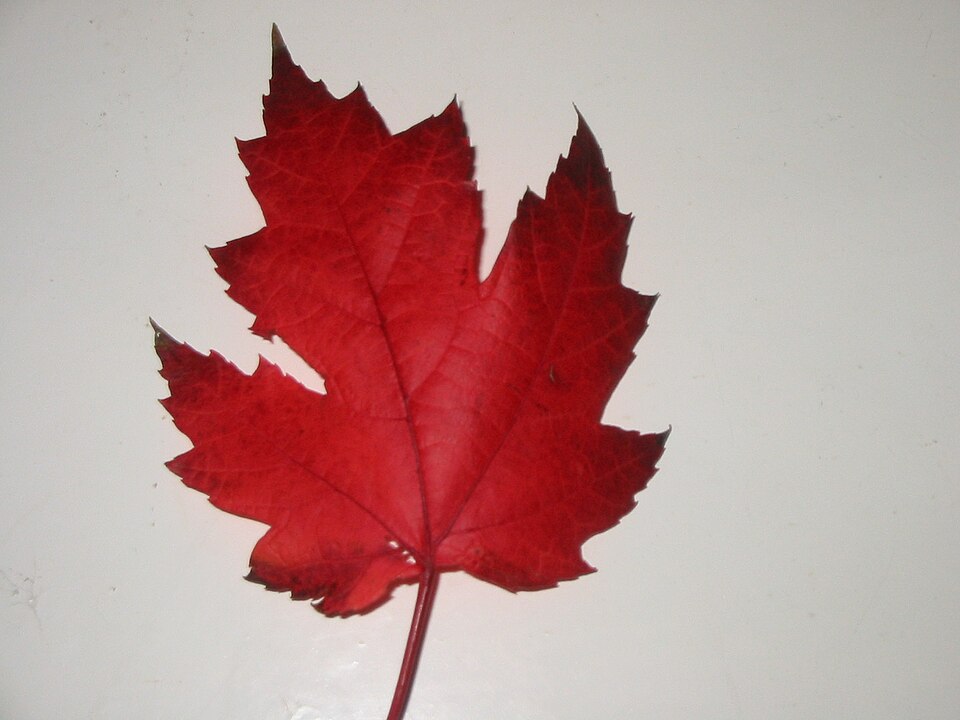
If Canada has a single symbol, it is the maple leaf. The maple has marked Canadian identity since the 19th century, and in 1965 it became the flag — a red leaf on white, with red bars at the sides — after a debate so bitter it nearly brought down the government. The beaver, the fur trade's currency, is the national animal; the loon, whose call is the sound of the northern lakes, is on the dollar coin Canadians call the 'loonie'. The national winter sport is ice hockey, the national summer sport is lacrosse — a game the Haudenosaunee played long before Europeans arrived — and the country's unofficial anthem, after 'O Canada' itself, might be the sound of a hockey crowd singing on a Saturday night.
There are softer symbols too, and Canadians know them: the politeness the world jokes about, and the apology — 'sorry' — that Canadians say so often it has been studied by linguists. There is the coffee-and-doughnut shop on every corner, the canoe on the lake, the red-and-white jersey at the Olympics, and the poppy worn in November for the war dead. None of these is the whole story, and Canadians themselves argue about which of them matter. But together they add up to something recognisable: a northern country, built on ice and water and forest, that thinks of itself as decent, modest, and a little bit different from its neighbour.
A country still defining itself
Canadian identity has always been a work in progress, and the work is not finished. The country is still arguing about Quebec's place in it, about reconciliation with Indigenous peoples, about how much immigration it wants and from where, and about what it owes the world — as a peacekeeper, as an Arctic nation, as a country whose north is warming faster than almost anywhere on earth. The argument is not a sign of failure. It is the way Canada has always worked: a federation built by negotiation, a culture built by addition, a country that decided, in 1971, that having no single official culture was itself a kind of identity.
The writer Northrop Frye once said that Canada's central question is not 'Who am I?' but 'Where is here?' — a country defined by its place, by its cold and its size, rather than by a single story. A thousand years after the Norse built their camp at L'Anse aux Meadows, and a century and a half after four provinces became a Dominion, Canada is still answering that question: a northern country, two languages, many peoples, one maple leaf, and an argument that has lasted for generations and shows no sign of ending.
| Milestone | Date | What happened |
|---|---|---|
| Milestone | Date | What happened |
| O Canada adopted as national anthem | 1980 | Anthem made official (written 1880) |
| Official Languages Act | 1969 | English and French become official languages |
| Multiculturalism policy announced | 8 Oct 1971 | First country in the world to adopt it |
| Charter of the French Language (Quebec) | 1977 | French made the official language of Quebec |
| New flag adopted | 15 Feb 1965 | Red maple leaf replaces the Red Ensign |
| Multiculturalism Act | 1988 | Policy given the force of law |
| National Day for Truth and Reconciliation | 30 Sept 2021 | First annual day of remembrance |
| 2021 Census | 2021 | 1.8m Indigenous people; 200+ ethnic origins reported |
Sources: Pier 21 Canadian Museum of Immigration, 'Canadian Multiculturalism Policy, 1971'; The Canadian Encyclopedia, 'Multiculturalism' and 'Royal Commission on Bilingualism and Biculturalism'; Statistics Canada, 2021 Census. Checked 29 November 2026.